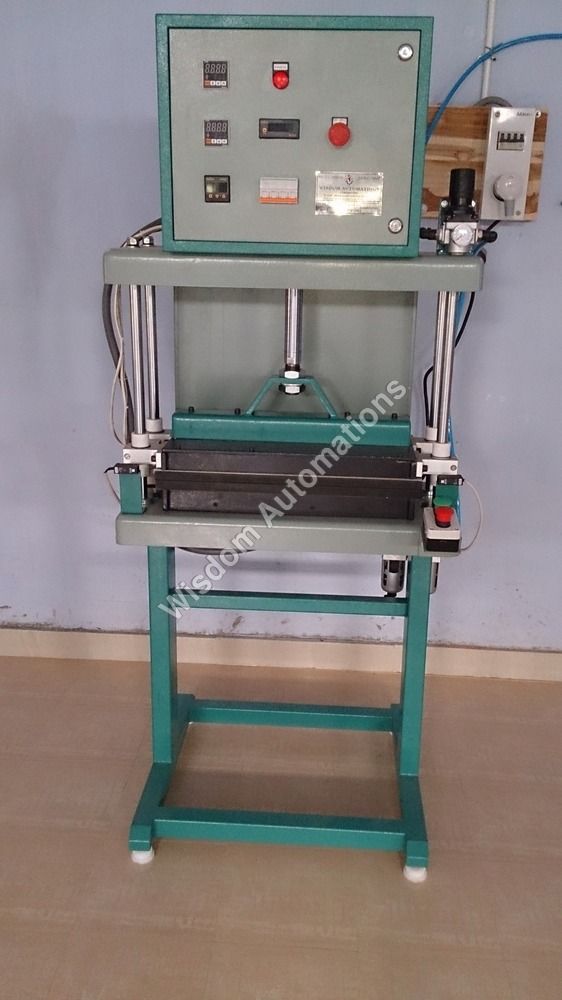
Paratha pressing machine can be foun in food processing industry along with other such machine, like half cooked paratha making machine, paratha cooling conveyor, etc. The operator of the machine can set the specifications, like the required diameter and thickness of flatbread. BPMPS â 1200 model paratha pressing machine has a capacity to press 1000-1200 ball dough into flatbread per hour. The machine is coated with OTFE and MS powder. It has 8 KW heater and runs on 0.5 HP power. At each stroke, it can press four pieces of 6'' to 8''. For automated operations, this machine has an operating panel with timers, and temperature controller. No oil is required for this process. Uncooked parathas are formed in this machine. This machine along with other paratha making machine works continuously for hours, without any downtime. Get complete information about this information by contacting us.
Model No.: BPMPS - 1200
Specifications:
Capacity: 1000-1200 Pieces per hour
PTFE Coated, MS Powder Coated
Power : 0.5 HP & 8 KW Heater, 3 Ph + N
No. of Pieces at a stroke : 6'' to 8'' - 4 Pieces
Operating Panel with Timers, Temperature controllers & Counter
Cutting-Edge Technology for Consistent ResultsUtilizing a digital touch panel and PLC-based control system, the Paratha Pressing Machine streamlines operations to produce uniformly pressed parathas with minimal manual intervention. The computerized automation assures repeatable precision, while variable speed options accommodate different production requirements.
Robust, Hygienic Design for Commercial UseManufactured with food-grade SS304 stainless steel, this machine ensures both durability and hygiene, suitable for continuous use in demanding environments. Easy-to-detach parts and a fully automatic lubrication system simplify maintenance, supporting an 8-hour continuous operation cycle.
Safety and Convenience Built-InSafety is prioritized with an emergency stop switch and overload protection mechanisms. The air-cooled system maintains optimal operation even in high-humidity conditions, and castor wheels provide effortless mobility. The machine is engineered for easy installation and low maintenance, making it ideal for fast-paced commercial setups.
FAQs of Paratha Pressing Machine:
Q: How does the Paratha Pressing Machine ensure uniform thickness for each paratha?
A: The machine allows users to set the pressing thickness within a range of 1 mm to 8 mm using its digital touch panel. The PLC-based control and computerized automation guarantee that each paratha is pressed to consistent specifications for uniform results every time.
Q: What materials are used in the construction of this machine, and how does it benefit food safety?
A: The Paratha Pressing Machine is built from food-grade SS304 stainless steel, ensuring that all surfaces in contact with dough are hygienic and resistant to corrosion. This material choice upholds food safety standards required in professional kitchens.
Q: When is maintenance required, and how is it carried out?
A: Routine maintenance is minimized due to its automatic lubrication system and easy-to-detach parts, which allows quick cleaning and inspection. Spare parts are readily available, ensuring minimal downtime during preventive or corrective maintenance.
Q: Where can this machine be installed, and is it easily movable?
A: The Paratha Pressing Machine is floor-mounted but comes with castor wheels, so it can be relocated easily within commercial kitchens or food processing units. Its robust and compact design fits conveniently into various workspace layouts.
Q: What is the process for operating the machine, and is technical knowledge required?
A: Operation is straightforward via a digital touch panel, with manual or automatic feeding options. The user-friendly interface and PLC-based system simplify control, so extensive technical expertise is not necessary for daily operation.
Q: How does the machine maintain optimal performance in humid environments?
A: With an air-cooled system and an ambient humidity tolerance up to 90%, the machine operates reliably even in high-moisture settings typical in many commercial kitchens, preventing overheating and ensuring consistent output.
Q: What are the key benefits of using this machine in paratha production?
A: The machine boosts productivity by enabling high-capacity, uniform paratha pressing with low noise and energy efficiency. Its robust design, low maintenance requirements, and multiple safety features contribute to improved workflow, product quality, and operator safety.